Knowledge Is the Competitive Advantage Most Organizations Overlook
Every organization generates knowledge through its employees, products, services, customers, projects, and daily operations. Yet valuable information often becomes fragmented across email inboxes, shared drives, spreadsheets, documents, meetings, applications, and institutional memory.
At ITKM Marketing Solutions, we help organizations transform information into a strategic business asset. Through Knowledge Management, Information Architecture, content governance, and collaboration solutions, we create structured environments that improve productivity, decision-making, operational efficiency, and organizational awareness.
Knowledge is most valuable when it can be captured, organized, discovered, shared, and applied. Our mission is to help organizations build knowledge ecosystems that connect people, processes, content, products, logistics, technology, and decision-making within a unified operational framework.
The Knowledge Ecosystem
Effective Knowledge Management connects people, processes, content, and technology. Each component contributes to a shared operational picture that turns disconnected information into usable organizational knowledge.
People
Employees, leadership, subject matter experts, vendors, partners, and customers contribute knowledge that must be captured, shared, retained, and applied throughout the organization.
Processes
Workflows, procedures, governance policies, approvals, and operational standards create organizational consistency, accountability, and repeatable execution.
Content
Documents, reports, product information, training materials, marketing assets, records, standard operating procedures, and compliance documentation form the organization’s information base.
Technology
Microsoft 365, SharePoint, Teams, Power Platform, document management systems, collaboration tools, workflow automation, and Commercial Off-The-Shelf technologies support the knowledge environment.
Knowledge Management Services
ITKM designs practical knowledge structures and collaborative environments around the way an organization actually works, communicates, develops products, manages content, and makes decisions.
Information Architecture
Develop logical information structures, taxonomies, metadata frameworks, navigation systems, and classification strategies that make information easier to discover, understand, manage, and reuse.
Content Governance
Establish ownership, content standards, publishing workflows, approval requirements, review cycles, retention practices, and lifecycle policies that support information quality and consistency.
Collaboration Solutions
Create connected workspaces that enable departments, employees, partners, vendors, and stakeholders to communicate, share information, manage tasks, and coordinate activities.
Operational Workbenches
Develop role-based work environments that bring together the information, applications, reports, tasks, procedures, references, and tools required to perform a specific operational function.
Product and Logistics Knowledge
Organize product specifications, packaging requirements, inventory information, supplier records, fulfillment procedures, compliance documentation, customer information, and marketing assets.
Workflow Optimization
Analyze business processes and develop repeatable procedures, approval paths, task flows, governance controls, and automation opportunities that improve efficiency and accountability.
The ITKM Difference
Many organizations treat Knowledge Management as document storage or file organization. ITKM treats Knowledge Management as an operational capability that connects information, people, technology, products, logistics, procedures, and decision-making.
Drawing upon military-informed planning methodologies, information management principles, and enterprise collaboration strategies, we help organizations establish a common operating picture. This approach improves situational awareness, coordination, accountability, continuity, and operational execution.
The result is a more informed and resilient organization capable of making faster decisions, preserving institutional knowledge, reducing duplicated effort, and adapting as operational requirements change.
- Mission-focused information architecture
- Structured content and document governance
- Cross-functional collaboration environments
- Role-based operational workbenches
- Process mapping and workflow optimization
- Product and logistics information management
- Knowledge retention and lessons learned
- Scalable governance frameworks
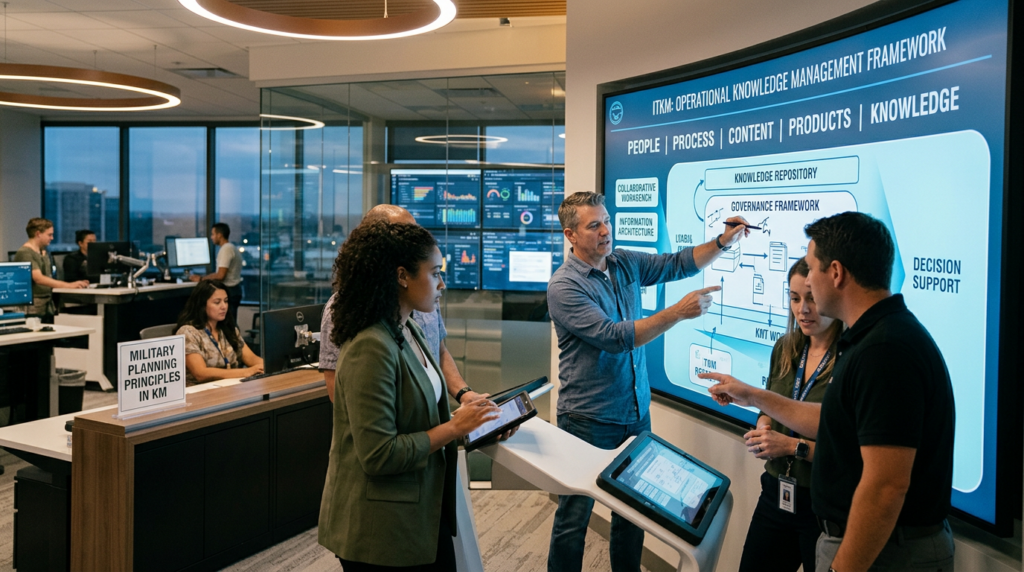
The ITKM Knowledge Management Framework
ITKM uses a structured lifecycle to move knowledge from disconnected information into daily operations, collaboration, decision support, and continuing organizational improvement.
Capture
Collect institutional knowledge, operational data, lessons learned, documentation, and subject matter expertise.
Structure
Apply information architecture, metadata, taxonomy, classification, and governance.
Collaborate
Connect teams and stakeholders through shared workspaces, content, communication, and coordinated workflows.
Operate
Integrate verified knowledge into business processes, projects, products, customer service, and decision-making.
Optimize
Use feedback, analytics, lessons learned, and operational results to improve knowledge assets and processes.
Built Using Proven COTS Technologies
Rather than relying on unnecessary custom-built software, ITKM uses Commercial Off-The-Shelf technologies whenever practical to create Knowledge Management environments that are scalable, supportable, cost-conscious, and aligned with operational requirements.
ITKM combines these platforms with information architecture, governance, collaboration design, business process analysis, content standards, and operational planning. This allows organizations to maximize existing technology investments while improving information discovery, coordination, visibility, and decision-making.
The result is an integrated knowledge ecosystem that supports organizational continuity, preserves institutional knowledge, strengthens operational performance, and provides a scalable foundation for future growth.
Transform Information Into Organizational Capability
The ability to capture, organize, govern, share, and apply knowledge can determine whether an organization leads or falls behind. ITKM helps businesses build the structures, collaborative environments, governance frameworks, and operational processes needed to turn information into measurable business value.